
On June 10, 2026, SEACPN held a public workshop to share several years of experience of regular CSO-tech engagement through the following event at DRAPAC 2026 Manila:
Inside the Black Box: Mapping Civil Society Engagement with Big Tech on Content Moderation
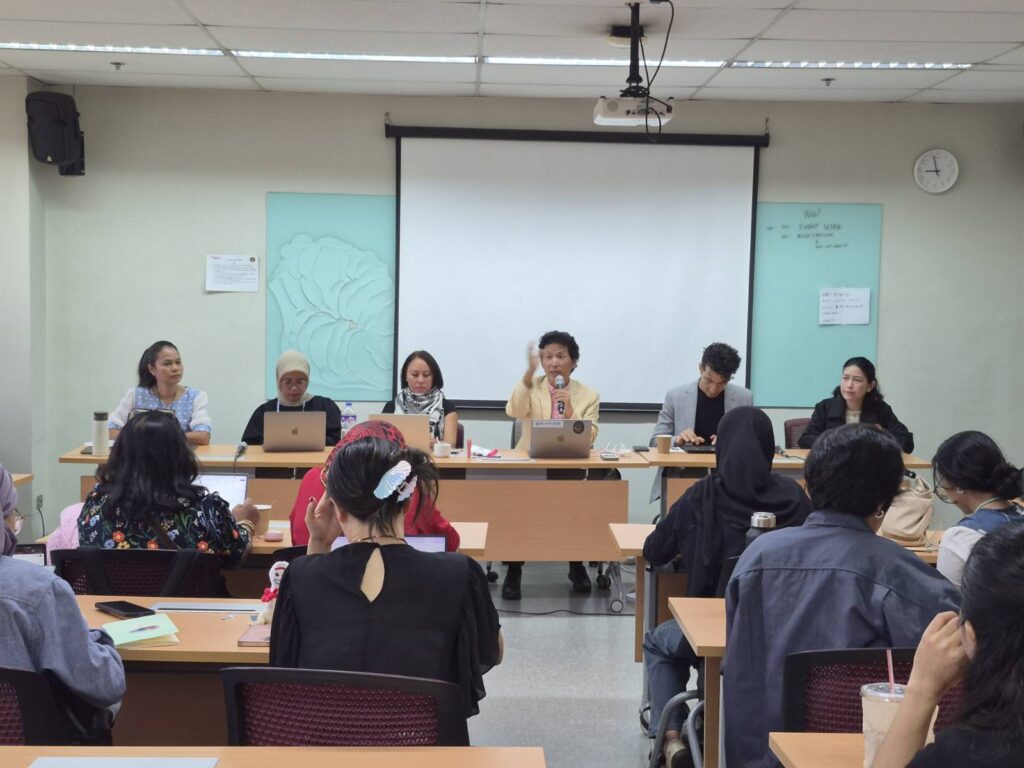
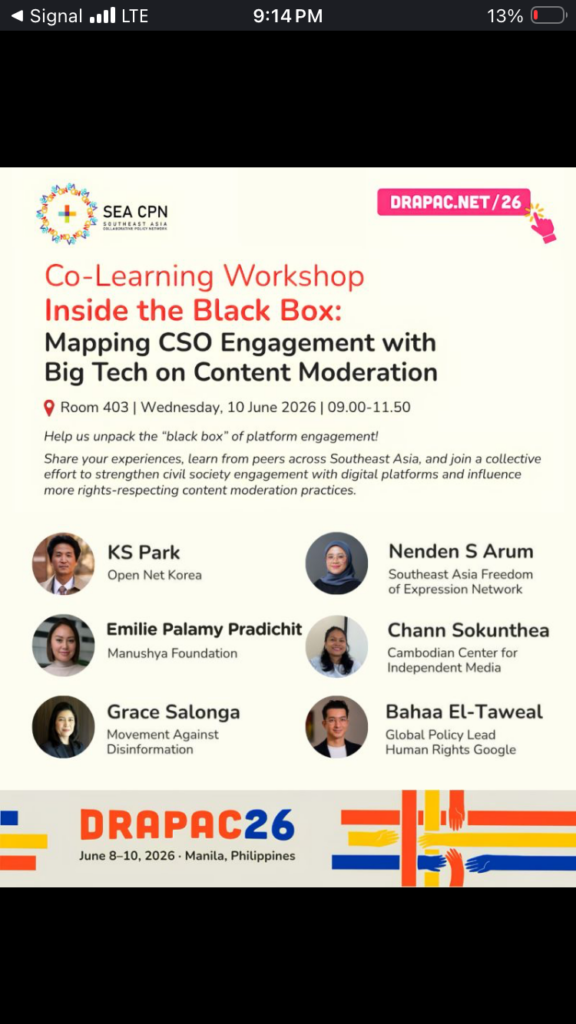
Wednesday, June 10, 2026 (Day 3) 09:00–11:50 (UTC+8); Room 403, University of the Philippines Bonifacio Global City
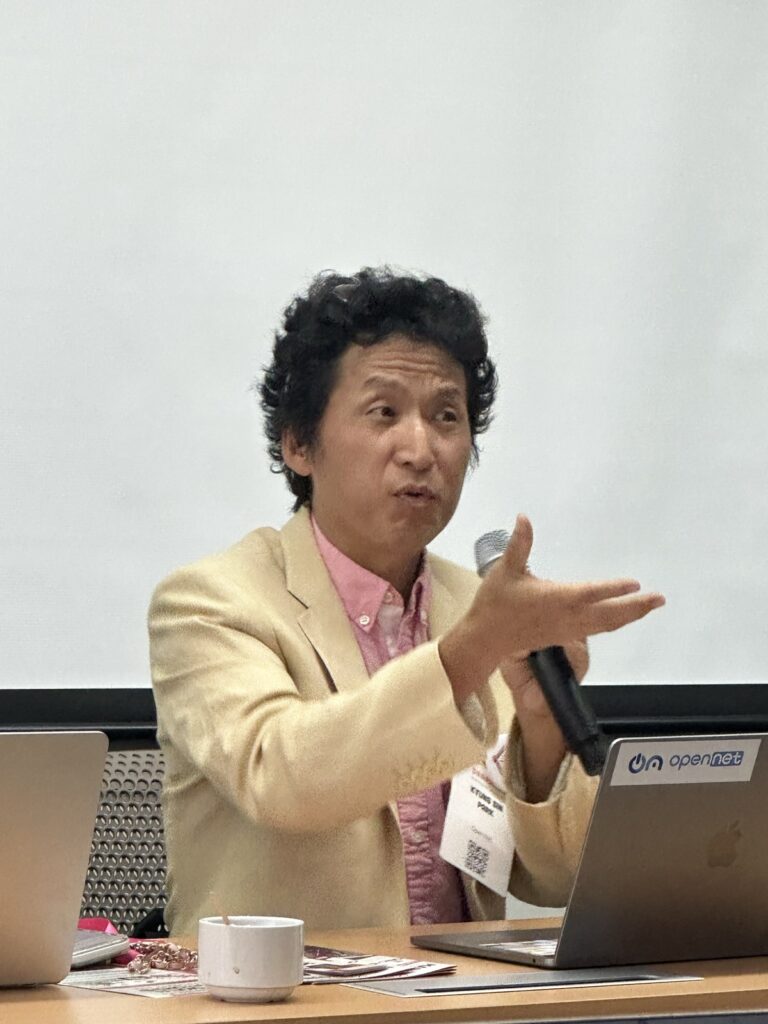
MODERATOR: KS Park, Open Net Korea
PRESENTERS:
- Nenden Sekar Arum, SAFEnet
- Liza Garcia, Foundation for Media Alternatives
- Chann Sokhuntea, Cambodian Center for Independent Media (CCIM)
- Grace Salonga, Movement Against Disinformation
- Bahaa El-Taweal, Google, Public Policy and Global Human Rights
- Emilie Pradichit, Manushya Foundation (Cambodia)
Civil society organisations (CSOs) across Southeast Asia increasingly engage with technology platform companies on issues related to content moderation, online harms, misinformation, and freedom of expression. These engagements range from reporting harmful content and escalating moderation failures to participating in trust-and-safety consultations, policy advocacy, and election-integrity initiatives.
However, access to these engagement channels is highly uneven across the region. While some CSOs have established communication with platform policy or trust and safety teams, others face significant barriers, including the absence of local company representatives, opaque escalation mechanisms, and broader power imbalances between civil society and the private sector. These disparities often limit CSOs' ability to address moderation failures affecting local languages, political contexts, and vulnerable communities. This interactive workshop will map CSOs' experiences in engaging with technology platforms on content moderation policies and practices in Southeast Asia. Through facilitated discussions and collaborative mapping exercises, participants will identify existing engagement mechanisms, challenges, and opportunities to strengthen regional coordination.
The workshop aims to generate a shared understanding of CSO–platform engagement in the region and identify pathways for more equitable and effective collaboration going forward.
Participants will:
- Share experiences engaging tech platforms on content moderation and trust & safety issues.
- Identify common barriers to effective CSO–platform engagement in Southeast Asia.
- Co-create a regional map of engagement mechanisms and gaps.
- Explore strategies for more transparent, accessible, and rights-respecting content moderation systems.
Notes from the session:
Nenden Arum, SAFEnet
- SAFENet is tracking all cases of UU ITE weaponization against HRDs, journalists, women victims of abuse, and student activities
- State-backed digital attacks: doxxing, hacking, account suspensions, coordinated harassment
- Big tech complicity being suspected: Meta, Tiktok, and otheres restricting content during 2025 protests at government pressure; removing evidence of police violence
- Internet shutdowns & throttling: documented during 2019 Papua protests and 2024/2025 political demonstrations
- Gender-based online violence: Women activists specifically targeted via doxxing and sexual threats
- Cybercrime Convention is amplifying these patterns: Indonesia can now formally request subscriber data and communications of Indonesians abroad who post criticism, without those posts being "criminal" in the host country. Also, in 2025, National Police and Ministry of Communication directed social media takedowns. "Production orders" under Article 27/28 creates an international legal basis under the Cybercrime Convention, to induce foreign tech companies to comply by either takedown or user data access.
Chann Sokhuntea, Cambodian Center for Independent Media (CCIM)
- Transnational repression people flying to neighboring countries to seek asylum.
- Facebook (Meta) starts techno-colonialism. Coordinated report by fake accounts towards activist accounts --> concerned that Meta may not have human being to check content moderation.
- Content disappearing before critical moments (i.e. elections) and it is not a mistake as told by Meta.
- It is to monitor activists movement (in Laos) to target activists online.
- Woman human rights defenders face a harder challenge
- Platform also leads to genocide
- Restoration of content is not a remedy - forced to engage with the platform - losing the campaign sequence
- Needed: meaningful remedy rethink about accountability: (1) corporate accountability; (2) environmental accountability
- Gemini is designed to support US military to support Palestinian genocide
Grace Salonga, Movement Against Disinformation (MAD)
- Meta is involved in the electoral disinformation in PH
- Engagement in tech platform PH - consultation, fact-checking
- 2021 MAD’s experience - wrote to Facebook on disinformation and electoral information
- HR assessment and content moderation to protect electoral integrity promised
- Constructive discussion does not lead to constructive solution
- Meta knows how to When, What, How to act
- Fake news evolved - politiical consultations, coordinated online communities, influencers - system that profitable to shape public opinions
- Pre-2022 elections: successful engagement communication channels opened | unsuccessful the result of dialogue is different form the practice in the field
- Facebook remains the primary platform to share electoral disinformation
- Journalist Concorales critical report becomes the target “red-tagging” online Facebook accomodate the red-tagging, despite complaints
- Through legal remedies platform becomes more responsive and explainable
- The prospect of legal accountability changing platform behavior
- What needs to change not a content moderation issue merely: coordinated manipulation, business model reward outreach, algorithmic
- Accountability under the law
- Lesson learned: (1) dialogue does not substitute accountability tech company shall do the right thing; (2) real change happens with real responsibility
Bahaa El-Taweal, Google (Google Policy and Google HR Team)
- Trying to engage more with civil society, like attending events (DRAPAC, Rightscon)
- Remove, Reduce, Raise, Reward (principle in Youtube) to measure impact of the content
- A lot of creators have a full time job to make money out of Youtube - raising the bar to monetize the content is tricky.
- Civil society contents being taken down : "If it has never been seen before, the system responds to it as something new and takes a longer time to process it."
- Allows grievance mechanism.
Emilie Pradichit, Manushya Foundation (Cambodia)
- Manushya Foundation provides training for citizen journalists related to the issue for public goods
- Hard to get resources in local language
- Working with diplomats of other countries because it is hard to engage with the domestic government
- Never received draft of Cyber Security Law from the government officially, but Meta, Google, and big techs are involved
- Cambodia will have elections 2027. During previous elections, CSO becomes targeted, especially opposition side
- Want to see how to get support regionally
- Definition of fake news from the ministry is not clear
Questions
- How does Google apply business and human rights principles?
- Do tech company considers political and democratic situation in the respective countries when trying to comply with the laws and principles in the certain countries?
- Is the prioritized engagement with the CSO or with the government? CSOs somehow is not on the same page with the government. In times of dilemma, does platform choose engagement with CSO or government?
Answers (Bahaa, Google)
- HR assessment is conducted for the new product or model, to assess the risk, and works with experts. For the present model, assessment is conducted the same.
- Google has separate teams to do the engagement: with government and with big organizations, etc. Cannot choose, there will be difficulties. No reason to choose.
- On law-making, most of the lawmakers do not care about the engagement with the companies and do not involve CSOs nor company. If they are asking genuine feedback, Google provides the feedback on the proposed legislations. But at the end of the day, its the law-makers to choose whether or not to accommodate it
- To comply with the law where Google operate, we follow strict legal process involving specific legal experts. If the request is believed to be not legal, bring it to the court or leave the country (i.e. Russia). Or in other case, the countries will ban the tech (i.e. Youtube)
- Feedback from civil society varies, some may take a longer time to respond.
Background: As digital authoritarianism and state sponsored disinformation are on the rise in Southeast Asia, digital rights civil society organizations in the region sought accountability and alliance with big techs to formulate an iteration that could help establish content moderation and data access consistent with international human rights and local nuances and knowledge. One such group is Southeast Asian Collaborative Policy Network (SEACPN) a network of 14 civil society organizations including Open Net, who warmed up with the three public events at DRAPAC 2023 Chiang Mai https://www.opennetkorea.org/en/wp/4720 (May); Rightscon 2023 Costa Rica https://www.opennetkorea.org/en/wp/4762 (June); and APrIGF 2023 Brisbane https://www.opennetkorea.org/en/wp/5022 (August) to discuss the need for a regional CSO-tech alliance in better content moderation. In parallel, Open Net met virtually with Google APAC content moderation team in May 2023 together with SAFEnet to probe the need for such engagement https://www.opennetkorea.org/en/wp/4784 and also met with Google’s Global Human Rights Team at Rightscon 2023 Costa Rica in June to explore a company-wide support for such iteration https://www.opennetkorea.org/en/wp/4787.
As a result, SEACPN began a series of meetings with Google and Meta as follows:
- Google at 2023 Kyoto IGF https://www.opennetkorea.org/en/wp/5578
- Google at 2024 Seoul Summit for Democracy https://www.opennetkorea.org/en/wp/5561
- Meta at 2024 Taipei APrIGF https://www.opennetkorea.org/en/wp/6041
- Google at 2024 Taipei APrIGF https://www.opennetkorea.org/en/wp/6035
- Meta at 2025 Rightscon Taipei https://www.opennetkorea.org/en/wp/6945
- Google at 2025 Rightscon Taipei https://www.opennetkorea.org/en/wp/6947
- Google at 2025 Oslo IGF https://www.opennetkorea.org/en/wp/6762
- Meta at 2025 DRAPAC Kuala Lumpr https://www.opennetkorea.org/en/wp/6931
- Google at 2025 APrIGF Kathmandu https://www.opennetkorea.org/en/wp/7320
- Meta near 2025 APrIGF Kathmandu https://www.opennetkorea.org/en/wp/7367
The public sessions continued now to allow SEACPN members to share their closed-door engagement experience with the wider public at 3rd Summit for Democracy https://www.opennetkorea.org/en/wp/5527 (March 2024) and Rightscon 2025 Taipei https://www.opennetkorea.org/en/wp/6326. This meeting at DRAPAC 2026 Manila is the 3rd public session since the confidential meetings have begun.
0 Comments