
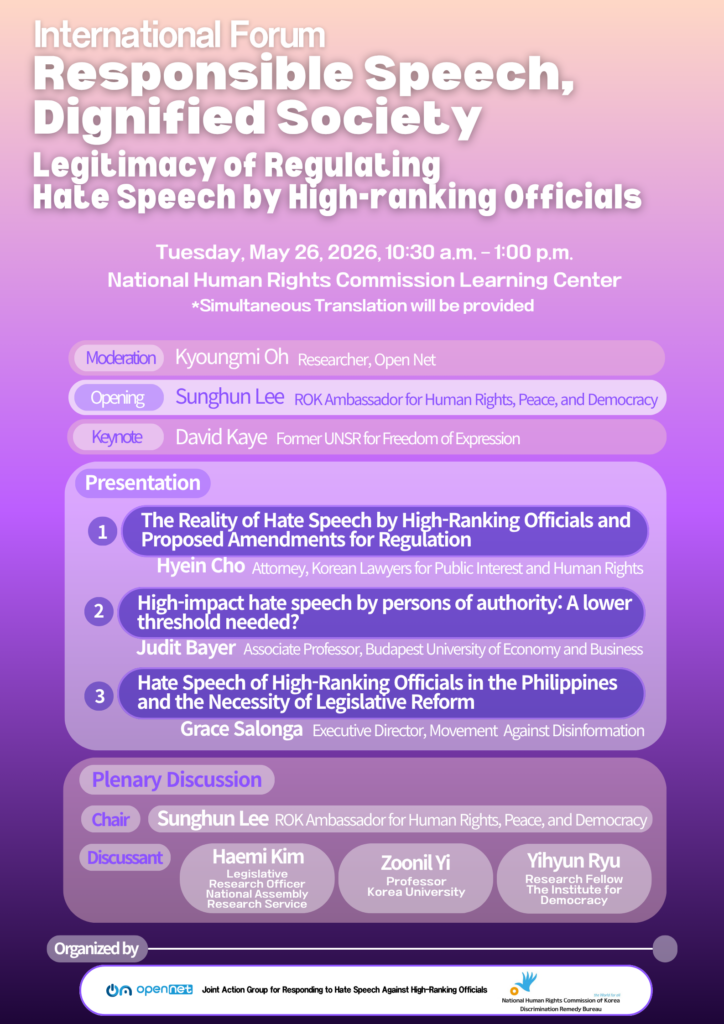
The public discourse of high-ranking officials shapes societal norms and exerts a profound influence on the public. Recently, hate speech by high-level figures has emerged as a grave threat, undermining democratic values and exacerbating social polarization. This forum seeks to examine international standards that promote accountability and dignity of high-ranking officials. The goal of the forum is to establish a firm legal and ethical foundation for regulating such speech, while maintaining the freedom of expression of the public as a principle.
To this end, we have invited the former UN Special Rapporteur for Freedom of Expression, David Kaye, alongside international legal experts and civil society activists from Southeast Asia. The former UNSR for Freedom of Expression will underscore that regulating hate speech by public officials, far from curtailing free speech, is an essential prerequisite for ensuring the inclusive democratic participation of all citizens. Furthermore, Judit Bayer draws European frameworks that strictly prohibit incitement to discrimination and violence. That will aim to affirm that Korea’s proposed legislative reforms align with global human rights benchmarks. By sharing insights from Grace Salonga, a Southeast Asian activist and attorney defending journalists who are struggling with red tagging by the governments, we hope that Korea’s legislative efforts will be a vital milestone for human rights solidarity and democratic progress across Asia.
- Date & Time: May 26, 2026(Tue) 10:30 - 13:00
- Venue: National Human Rights Commission of Korea
- Host: Open Net, Joint Action Group for Responding to Hate Speech by High-Ranking Officials, National Human Rights Commission of Korea Discrimination Remedy Bureau
- Moderation: Kyoungmi (Kimmy) Oh (Researcher, Open Net)
- Time Table:
- 10:00 - 10:30: Registration
- 10:30 - 10:40: Opening Remarks (Sunghun Lee, ROK Ambassador for Human Rights, Peace, and Democracy)
- 10:40 - 11:00: Keynote Speech (David Kaye, former UNSR for Freedom of Expression)
- 11:00 - 11:20: Presentation 1 | The Reality of Hate Speech by High-Ranking Officials and Proposed Amendments for Regulation (Hyein Cho, Attorney, Korean Lawyers for Public Interest and Human Rights)
- 11:20 - 11:40: Presentation 2 | High-impact hate speech by persons of authority: A lower threshold needed? (Judit Bayer, Associate Professor, Budapest University of Economy and Business)
- 11:40 - 12:00: Presentation 3 | Hate Speech of High-Ranking Officials in the Philippines and the Necessity of Legislative Reform (Grace Salonga, Executive Director, Movement Against Disinformation)
- 12:00 - 12:10: Break
- 12:10 - 13:00: Plenary Discussion
- Chairperson: Sunghun Lee (ROK Ambassador for Human Rights, Peace, and Democracy)
- Discussant: Haemi Kim (Legislative Research Officer, National Assembly Research Service), Zoonil Yi (Professor, Korea University), Yihyun Ryu (Research Fellow, The Institute for Democracy)
International Legal Experts Forum
The Legislative Legitimacy of Regulating Hate Speech by High-Ranking Public Officials
1. Opening Remarks and Keynote Presentations
Framing the Issue and International Human Rights Standards
The Distinctive Nature and Urgency of Regulating Hate Speech by Public Officials:
Ambassador Lee Seong-hoon and former UN Special Rapporteur on Freedom of Expression David Kaye emphasized that hate speech by high-ranking public officials differs fundamentally from ordinary citizens’ speech in both weight and social impact. Because public officials speak with the authority of the state and public office behind them, their statements can have broad societal consequences, legitimizing discrimination and stigmatization against minorities and undermining democratic communities.
International Human Rights Framework:
David Kaye explained the balance under the United Nations’s International Covenant on Civil and Political Rights (ICCPR) between the principles of non-discrimination, protection of freedom of expression, and the obligation to prohibit incitement under Article 20. In particular, he proposed that the six-part test established in the Rabat Plan of Action — context, speaker status, intent, content and form, extent of dissemination, and likelihood of harm — should guide determinations on whether hate speech warrants regulation.
2. Main Presentations: Current Realities, Regulatory Models, and Comparative Cases
1) The Situation in Korea and Proposed Legislative Amendments
(Presentation 1 – Attorney Cho Hyein)
Attorney Cho Hyein pointed out that hate speech by politicians in Korea is disproportionately directed at socially marginalized groups, including women, LGBTQ+ persons, migrants, and persons with disabilities, thereby intensifying social conflict.
Rather than advocating a radical criminal-law-centered approach, she proposed a multilayered regulatory framework. Specifically, she suggested:
- introducing provisions into the National Human Rights Commission Act defining hate speech and authorizing investigations and corrective recommendations against high-ranking public officials;
- amending the National Assembly Act and Civil Service Act to impose official duties and disciplinary grounds related to hate speech; and
- explicitly codifying fair competition obligations under election law.
2) Balancing Regulation and Freedom, and the EU Framework
(Presentation 2 – Professor Judit Bayer)
Professor Judit Bayer noted that while hate speech harms pluralism and democratic discourse, excessive legal regulation risks being weaponized against political opponents.
She therefore emphasized the need for narrow and precise definitions and for limiting the scope of regulation to specific actors such as public officials and politicians. Criminal punishment, she argued, should remain a last resort, while alternative sanctions — including suspension of public funding, internal party discipline, and fines — should be considered, reflecting frameworks used by the European Union and the European Parliament.
3) The Philippine Experience of “Red-Tagging”
(Presentation 3 – Grace Salonga)
Grace Salonga highlighted the severe consequences of “Red-Tagging” in the Philippines, whereby government officials label human rights defenders, journalists, and labor activists as communists, exposing them to surveillance, threats, and even deadly violence.
She stressed that hate speech by high-ranking public officials, when combined with disinformation campaigns and fake news, distorts electoral processes and suppresses democratic participation, and therefore warrants heightened legal accountability.
3. Panel Discussion: Legislative Legitimacy and Effective Enforcement
1) Legislative Legitimacy Grounded in Public Officials’ Duties
(Kim Hyemi, Legislative Research Officer)
Kim Hyemi evaluated the proposed amendments as minimizing concerns over infringement on freedom of expression because they clearly target duty-bearers — namely public officials and politicians — rather than ordinary citizens, while imposing obligations tied to public office.
At the same time, she suggested examining issues of foreseeability when applying definitions developed for recommendation-based human rights mechanisms directly to disciplinary statutes. She also proposed developing clearer typologies of hate speech, such as repeated derogatory remarks or stigmatization through public authority, to improve enforceability.
2) A Securitization Theory Approach
(Ryu Ihyun, Research Fellow)
Drawing on securitization theory, Ryu Ihyun argued that when those in power portray certain groups — such as migrants or sexual minorities — as existential threats to the community, the speech act itself erases politics and legitimizes exclusion and violence.
Ryu also raised the question of whether deliberate inaction by public officials — such as knowingly tolerating or facilitating hate rallies or discriminatory incidents — should likewise become subject to regulation.
3) Restrictions as Relative Rights and the Marketplace of Ideas
(Professor Yi Zoonil)
Professor Yi Zoonil emphasized that under the Korean Constitution, freedom of expression is a “relative right” that may be restricted for the protection of others’ rights or the public interest. He argued that just as the state intervenes in economic markets to correct structural distortions, active state intervention is likewise necessary against hate speech that undermines fairness in the marketplace of ideas.
He further posed practical legislative questions to the presenters, including whether the scope of “high-ranking public officials” under the Public Service Ethics Act is appropriate and whether hortatory provisions in election law alone are sufficient to offset electoral incentives for hate speech.
4. Overall Summary of the Forum
Participants broadly agreed that hate speech by high-ranking public officials causes exceptionally serious social harm and therefore warrants standards distinct from those applied to ordinary citizens. At the same time, the forum concluded that rather than immediately resorting to criminal punishment, a multilayered and gradual legal framework — including human rights commission investigations, public-office disciplinary measures, and election-related obligations — would provide a more legitimate and effective approach that protects freedom of expression while ensuring accountability.
0 Comments