
Hate speech regulation must be understood within the context of redressing discrimination against minorities and designed in conjunction with anti-discrimination systems.
All candidates and political parties must pledge to refrain from hate speech during the local election.
The United Nations has pointed out that South Korea lacks explicit criminal provisions for racist hate speech and hate crimes.
Freedom of expression is for the marginalized; it is a tool for those resisting the establishment.
Moderator: Oh Kyoung-mi
Keynote Speech: Cho Hye-in (Hope and Law / Public Interest Human Rights Lawyers Group)
Legislative Remarks: Representative Son Sol
Legislative Remarks: Representative Yong Hye-in
Joint Action Group Remarks: * Choi Sae-yan (MINBYUN - Lawyers for a Democratic Society)
- Park Kyung-sin (Open Net Korea)
- Kim Ji-rim (GongGam - Public Interest Law Center)
Joint Statement: Doran (Parti Social Cooperative), Heewoo (Digital Justice Network)
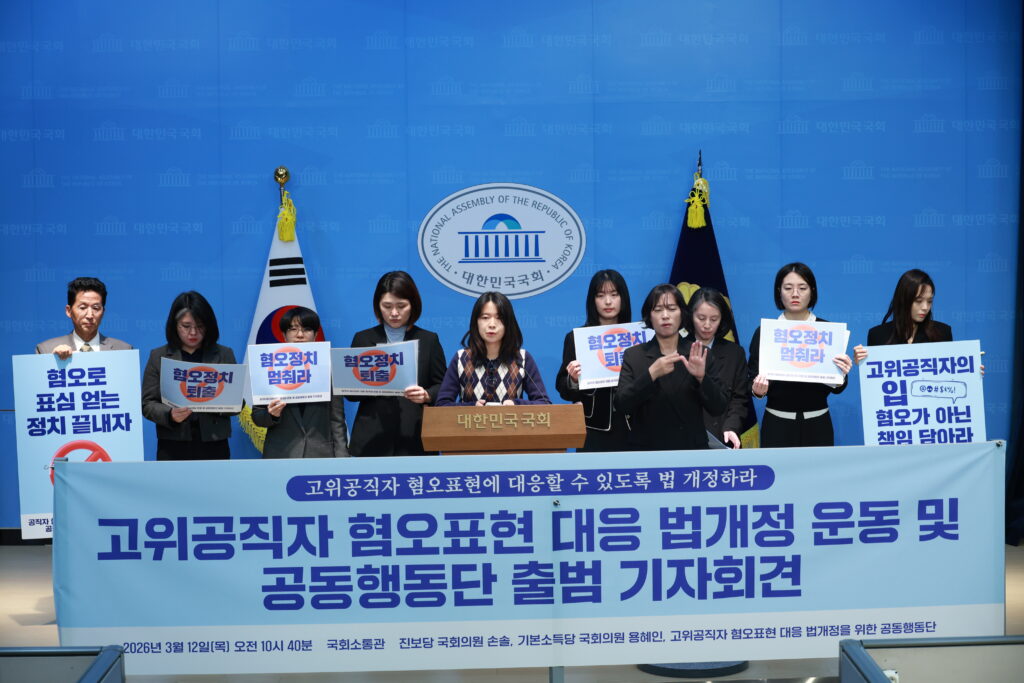
On March 12, 2026, the 'Joint Action Group,' by 12 civil society organizations including the GongGam Human Rights Law Foundation, Lawyers for Public Interest and Human Rights, Feminism with Men, Digital Justice Network, Rainbow Action, Lawyers for a Democratic Society, OpenNet, Parti Social Cooperative, Unni Network, Institute for Women's Cultural Theory, Migrant Human Rights Solidarity for the Enactment of the Anti-Discrimination Act, and Justice Memory Solidarity for the Resolution of the Japanese Military Sexual Slavery Issue, held a press conference to urge the enactment of a bill to amend the law to address hate speech by high-ranking public officials and to request the suppression of hate speech that is expected to intensify during the upcoming local elections.
The draft amendments are as follows. First, provisions regarding hate speech have been newly established in the National Human Rights Commission of Korea. Act, and the provisions of this law shall apply mutatis mutandis to the National Assembly Act, the State Public Officials Act, the Local Public Officials Act, and the Public Official Election Act. This is intended to establish a legal basis for regulating hate speech by high-ranking officials or Members of Parliament who have significant social influence, rather than by ordinary citizens. Given that general regulations on hate speech may inadvertently hinder the right to speak of the socially vulnerable, we intend to focus on responding to hate speech by high-ranking officials, where the need for regulation is urgent.
Attorney Cho Hye-in pointed out the harmful nature of hate speech that entrenches discrimination and emphasised the need for a multi-layered and comprehensive response system encompassing administration, policy, and social campaigns, moving beyond discussions focused solely on criminal punishment. Judging that hate speech by politicians and high-ranking public officials is the most urgent issue exacerbating social conflict, she proposed establishing a new provision defining hate speech within the National Human Rights Commission Act and strengthening the Commission's authority to investigate and recommend corrective measures. Furthermore, Attorney Cho urged that individual laws, such as the National Assembly Act, the Public Officials Act, and the Public Official Election Act, be designed to invoke the definition in the Human Rights Commission Act, thereby establishing a legal basis to enable effective disciplinary action and regulation against hate speech by public officials.
MP Son Sol criticized the reality in which politics exploits hatred and conflict against specific groups, and pledged to hold public officials and politicians accountable for their remarks and to establish legal and institutional mechanisms to prevent hate speech. In particular, MP Son presented the enactment of an anti-discrimination law and the regulation of hate speech within the political sphere as urgent tasks to protect dignity and equality, emphasizing the need to root out hate politics starting from the National Assembly and move toward a politics of respect and integration.
MP Yong Hye-in criticized the reality in which some politicians and high-ranking public officials profit politically by exploiting hate speech, and urged for discussions on fundamental regulatory legislation that would be applied first to the public service, rather than stopgap measures. Furthermore, ahead of the June 3 local elections, MP Yong pledged to promote human rights policies, including ordinances to prevent hate speech, while emphasizing that she would fulfill political responsibilities to restore the public sphere tainted by hatred and resolve discrimination.
Attorneys Choi Sae-yan, Professor K.S. Park, and Attorney Kim Ji-rim spoke as the representative at the Joint Action Group. Attorney Choi Sae-yan stated that inciting hatred against minorities by the political sphere is an act of violence that infringes upon fundamental rights and threatens democracy; therefore, Attorney Choi emphasized the need to clearly define hate speech and establish legal and institutional mechanisms to sanction it. Attorney Choi also urged all candidates and political parties in the upcoming local elections to pledge to cease hate politics, and pledged that the Joint Action Group would stand in solidarity until the end for legal reforms and awareness-raising activities to create a society free from discrimination and exclusion. Professor Park emphasized that while freedom of expression must be strictly protected and there is a concern that general regulations on hate speech could be misused as tools to suppress the voices of minorities, remarks by high-ranking public officials constitute a "clear and present danger" that incites discrimination and violence due to their authority and influence. Therefore, she stressed that regulating hate speech by high-ranking officials is an essential measure to protect the right to speak of the vulnerable from the incitement of vested interests and to establish true freedom of expression and equality in our society. Attorney Kim Ji-rim pointed out that xenophobic remarks by public officials, which are repeated every election season to gain votes, are irresponsible acts that spread racism throughout society and threaten the safety of minorities due to their authority. Attorney Kim demanded that, in accordance with the recommendations of the UN Committee on the Elimination of Racial Discrimination in 2025, Korea must break the practice of excusering hatred and incitement to discrimination as freedom of expression and promptly prepare effective legislation to regulate hate speech by public officials.
In addition, the Joint Action Group officially launched a campaign ( https://campaigns.do/campaigns/1798 ) in the name of the group solidarity along with this press conference.
The Joint Action Group, having officially launched with this press conference and begun its activities in earnest through a campaign, plans to do its utmost to ensure the successful enactment of this amendment through various activities, including signature campaigns, public opinion-building events, opinion polls, and international forums.
0 Comments