
26/10/2016
The government does not currently disclose data on search and seizure for communication service providers which contents and communication metadata as well as subscriber identifying information can all be acquired. Therefore, we have given the below analysis based on the numbers published by two major online service providers (OSPs), Naver and Kakao.
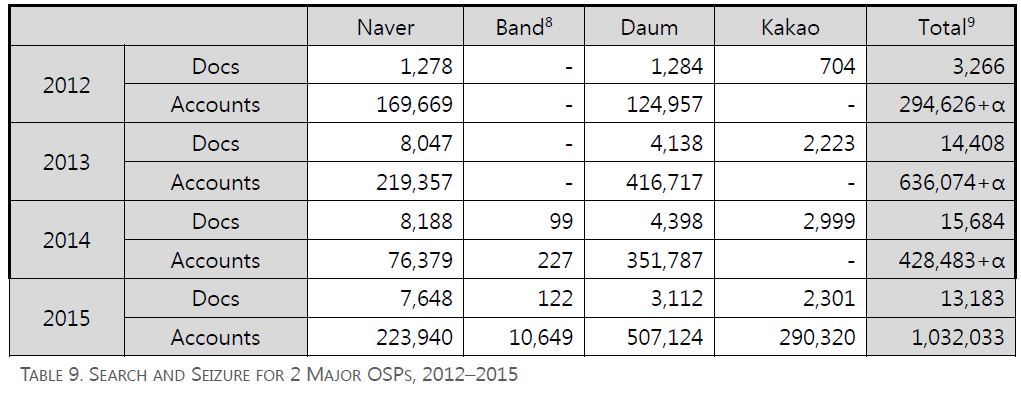
- According to the above chart, search and seizure for two major OSPs in 2015 numbered 13,183, for 1,032,033 accounts. In 2015, the total number of accounts subject to interceptions, acquisition of communications metadata, and provision of subscriber identifying information for these OSPs was only 13,374. Compared to this, over 1 million accounts subject to search and seizure show that search and seizure is the most prevalent method for internet surveillance.
- Also, accounts for each document is 78, showing that the scope of each search and seizure is very wide and comprehensive. In regards to search and seizure for Kakao, which dominates the online messenger service market with more than 90% of the market share, number of accounts per document is approx. 126.
- Let us assume that search and seizure is usually conducted to acquire a specific target of investigation’s communication contents after they have taken place. If we consider the ratio of accounts of two major OSPs for interceptions[1], we can roughly estimate that government search and seizure accounts for about approx. 3 million internet user accounts and approx. 10 million communications user information. If this estimate is reasonable, search and seizure on communication conducted on such a vast scale will be certainly the most serious problem, as it allows the government to see the contents of the communications.
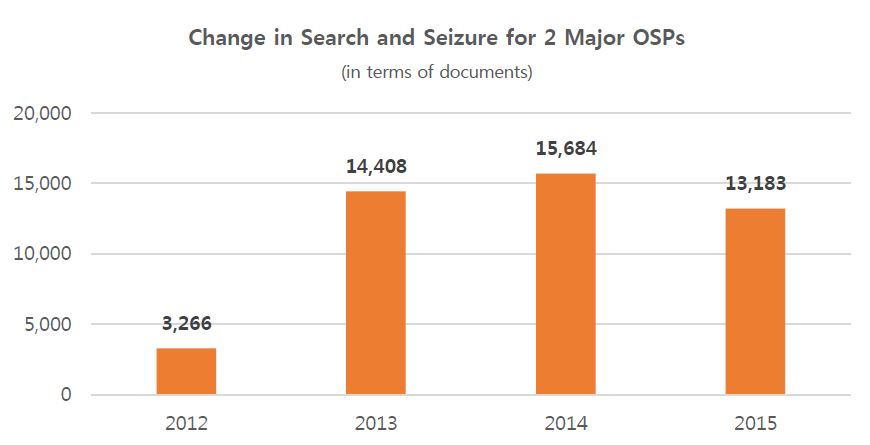
- Search and seizure for two major online service providers increased drastically in 2013, more than three times compared to the year before. After 2013, the numbers keep steady until 2015. Naver explains this as a ‘balloon effect’, with investigatory agencies relying on search and seizure to obtain subscriber identifying information after major portals stopped complying with requests of subscriber identifying information without court orders. However, while it is true that after provision of subscriber identifying information was stopped, the search and seizure increased, it cannot be wholly attributed to a balloon effect. In 2012, provision of subscriber identifying information by the two OSPs was conducted for about 25,000 requests covering about 130,000 accounts, while the increase in search and seizure after provision of subscriber identifying information was stopped was for about 10,000 requests covering at least 300,000 accounts. In other word, while search and seizure certainly could have increase in numbers as a replacement of provision of subscriber identifying information, the increase in the former is not enough to wholly replace the latter. Also to be noted is the fact that comprehensive search and seizure on internet communications (unrelated to provision of subscriber identifying information) has increased substantially.
[1] As of 2015, in terms of number of documents, approx. 23% of the total interceptions, approx. 42% of interceptions for internet. In terms of number of accounts, approx. 8% of the total interceptions, approx. 35% of interception for internet.
댓글 0개