
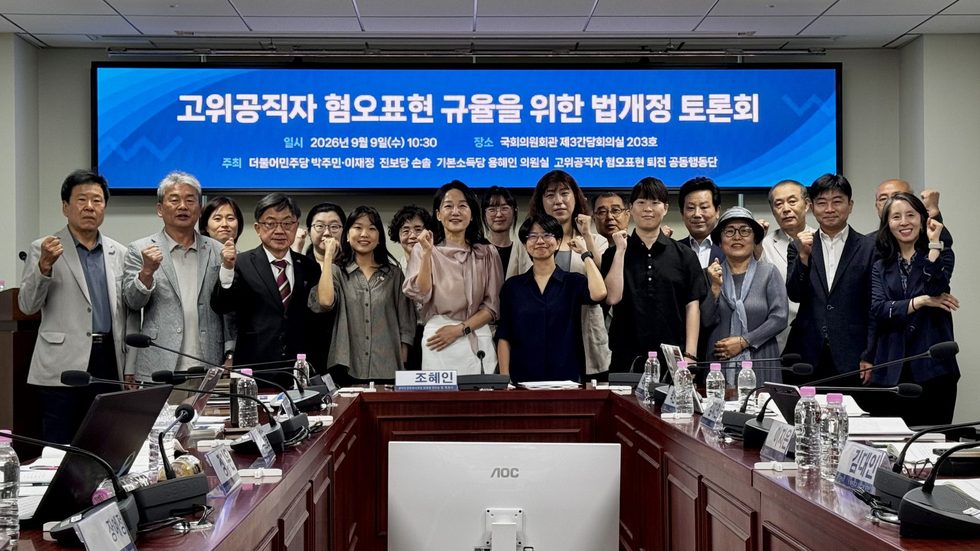
- Date & Time: Wednesday, September 9, 2026, 10:30–13:00
- Venue: Room 203, National Assembly Members' Office Building
- Hosted by: Rep. Park Ju-min and Rep. Lee Jae-jung (Democratic Party of Korea), Rep. Son Sol (Progressive Party), Rep. Yong Hye-in (Basic Income Party), and the Joint Action Group against Hate Speech by High-Ranking Officials
Summary
The panelists proposed establishing a tiered regulatory framework utilizing existing mechanisms—such as National Human Rights Commission of Korea (NHRCK) corrective recommendations, parliamentary disciplinary actions, public servant code of conduct obligations, and fair competition duties during elections—while holding high-ranking public officials to higher standards of accountability than ordinary citizens.
The panelists emphasized that hate speech by politicians and high-ranking officials carries significant social influence and promotes discrimination, warranting accountability standards commensurate with their public standing.
Keynote speaker Cho Hye-in, an attorney at Hope and Law, stressed that in light of international human rights standards, responses to hate speech must be structured across multiple levels depending on severity. Proposed measures included:
- Introducing an integrated definition of hate speech within the National Human Rights Commission Act.
- Placing hate speech made by high-ranking officials abusing their office or in connection with their duties under NHRCK investigation and corrective recommendations.
- Amending the National Assembly Act to designate hate speech by lawmakers as grounds for disciplinary action.
- Imposing statutory duties on national and local public servants to refrain from discrimination and hate speech during official duties.
- Codifying an obligation for political parties and election candidates to refrain from hate speech during campaigns.
Panel Discussion Highlights
Panelists underscored the necessity of establishing social response frameworks alongside statutory regulation:
- Park Jin-sol (Head of Media Monitoring Team, Citizens' Coalition for Democratic Media): Pointed out that statements by politicians and public officials are repeatedly amplified across the press, web portals, YouTube, and social media. She emphasized the need for news reporting standards to prevent media from uncritically broadcasting hate speech or amplifying it in headlines. She noted that evaluations must comprehensively consider context, the speaker's status, intent, form, impact, and the likelihood of inciting actual violence or discrimination, stating that related laws must serve "not as laws that silence speech, but as standards that prevent those in power from speaking recklessly."
- Jang Ye-jeong (Co-Executive Chair, Coalition for Enactment of the Comprehensive Anti-Discrimination Act): Agreed with prioritizing the regulation of hate speech by high-ranking officials, but stressed that enacting a comprehensive anti-discrimination act must proceed in parallel to resolve the absence of a basic law and establish societal benchmarks for what constitutes discrimination and hate.
- Jung Da-eun (Attorney, MINBYUN-Lawyers for a Democracy Society Gwangju-Jeonnam Branch): Cited instances of distortion, disparagement, and mockery of the May 18 Democratization Movement, noting that the harms of hate speech do not stem solely from outright false claims. She called for swift legislative action while addressing current procedural gaps in parliamentary discipline through follow-up legislation.
- Oh In-young (Platform Team Lead, Social Cooperative Parti): Observed that "the words of high-ranking public officials carry even greater power in digital environments." She stressed that regulating hate speech is not merely about restricting the speech of the powerful, but about ensuring that those previously silenced or marginalized by hate speech become visible and heard again, establishing conditions where diverse individuals can deliberate together in the public square.
- Park Han-hee (Co-Representative, Rainbow Action): Addressed recurring anti-LGBTQ+ rhetoric in political and electoral spheres, urging that the NHRCK Act clearly establish definitions and grounds for corrective recommendations, accompanied by ongoing human rights education, awareness campaigns, and public outreach alongside punitive measures.
- Kim Ji-yeon (Vice President, Korean Teachers and Education Workers Union): Argued that while inflammatory rhetoric from influential public officials goes unaddressed, strengthening anti-hate education and discipline solely within schools has limitations. She noted that setting societal accountability standards for public officials serves as an essential foundation for human rights and democracy education in schools.
- Lee Ji-eun (General Secretary, People's Solidarity for Participatory Democracy): Agreed with the need for regulation but advised defining targeted conduct strictly and narrowly to minimize infringement on freedom of expression, prioritizing a tiered system of civil, administrative, and institutional remedies over criminal penalties.
Panelists shared the consensus that the objective of regulating hate speech by high-ranking public officials is not to ban specific viewpoints, but to curb the spread of discrimination fueled by public authority and guarantee equal participation for all citizens in the public forum.
0 Comments