
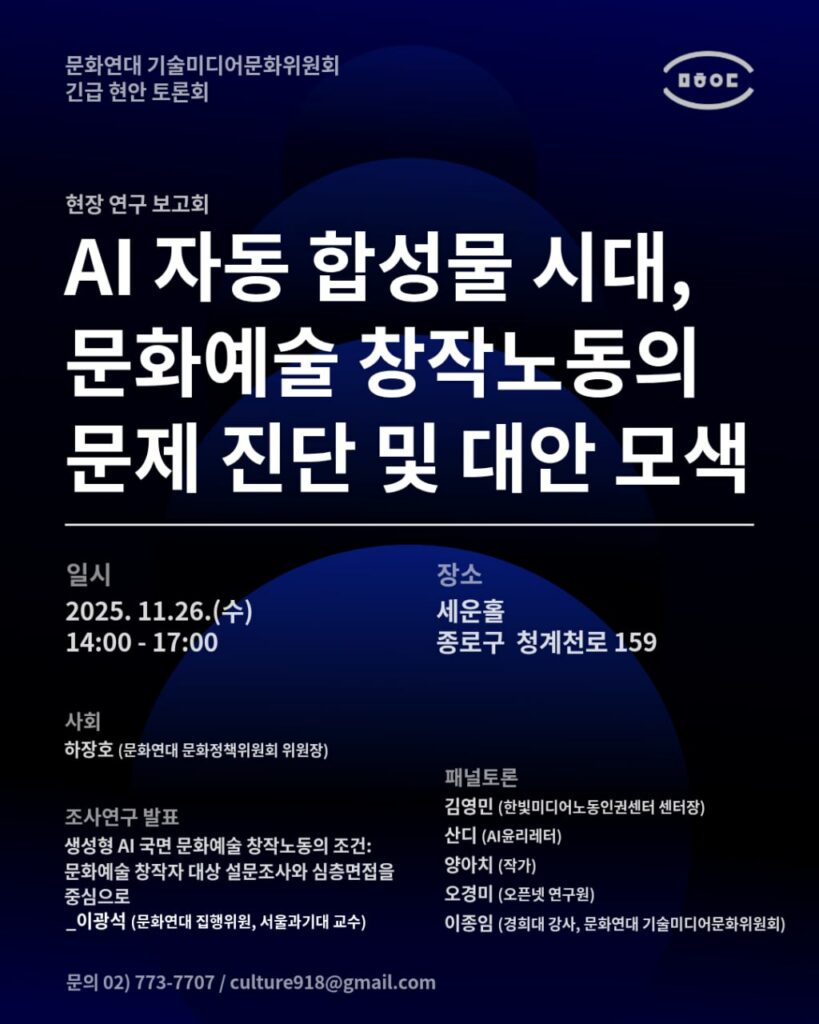
Date & Time: Wednesday, November 26, 2:00 PM – 5:00 PM
Venue: Sewoon Hall (159 Cheonggyecheon-ro, Jongno-gu)
Moderator
– Jangho Ha (Chair of the Cultural Policy Committee, Cultural Solidarity)
Speaker
– Kwang-suk Lee (Executive Committee Member, Cultural Solidarity / Professor, Seoul National University of Science and Technology)
Panel Discussion
– Youngmin Kim (Director, Hanbit Media Labor Rights Center)
– Sandi (AI Ethics Letter)
– Yangachi (Artist)
– Kyoungmi (Kimmy) Oh (Researcher, Open Net)
– Jong-im Lee (Lecturer, Kyung Hee University / Technology, Media, and Culture Committee, Cultural Solidarity)
Summary of Kimmy’s discussion
Kyoungmi (Kimmy) Oh provides a multidimensional analysis of generative AI, focusing on its technical mechanisms, copyright implications, and the lived realities of creators. She clarifies that image-generating AI does not “delete memories” in a literal sense; rather, it operates by analyzing statistical patterns and frequencies to build a model, rather than storing and erasing original images. She attributes the early controversies regarding AI generating near-identical copies to “overfitting”—where a model mimics specific data too closely—and notes that continuous refinement has naturally reduced these instances of excessive imitation. Furthermore, she expresses skepticism toward the idea that AI was designed with “data deletion” in mind, given that corporations currently face minimal risk in utilizing copyrighted works for training.
Regarding the socio-economic impact, Kyoungmi (Kimmy) Oh warns against allowing the critique of techno-optimism to devolve into “structural determinism.” She argues that the Korean cultural industry is not a monolith of passive victims; instead, creators exhibit a wide range of responses—from resistance and pragmatic acceptance as a tool to active utilization for new livelihoods, such as musicians creating AI-generated background music for YouTube. Interestingly, she suggests that the difficulty AI has in perfectly replicating a specific artist’s signature style might actually serve to protect the creator’s uniqueness. By invoking the “idea-expression dichotomy” in copyright law, she offers a provocative counter-argument: if human artists are granted copyright for new works inspired by styles they have learned from others, it is worth questioning why AI is viewed more harshly when it cannot even claim authorship of its creations.
Finally, while Kyoungmi (Kimmy) Oh strongly supports implementing “opt-out” settings as the default to protect creators, she remains cautious about the feasibility of collaborative solutions. Although establishing a consultative body is essential for reclaiming creator autonomy, she points out that the cultural and arts sector is internally fragmented by conflicting interests and hierarchical conflicts. This exclusionary structure makes it difficult to achieve the collective solidarity necessary to challenge the monopolistic power of tech giants and platforms. Despite these hurdles, she emphasizes that navigating these internal complexities is a prerequisite for any realistic defense of creators’ rights in the age of AI.


0 Comments