

On October 14, 2026, KS Park spoke at an Asian Privacy Day seminar organized by Privacy by Design Lab of Japan collaborating with Asian Pacific Digital Consumers Dialogue to discuss the smart TV targeted advertising that uses TV-watching behavioral data to expose the users with targeted advertising, installed on smart TVs. KS Park hosted a fireside chat with Jeff Chester, Center for Digital Democracy, who has published How TV Watches Us in 2024 exposing the practice.
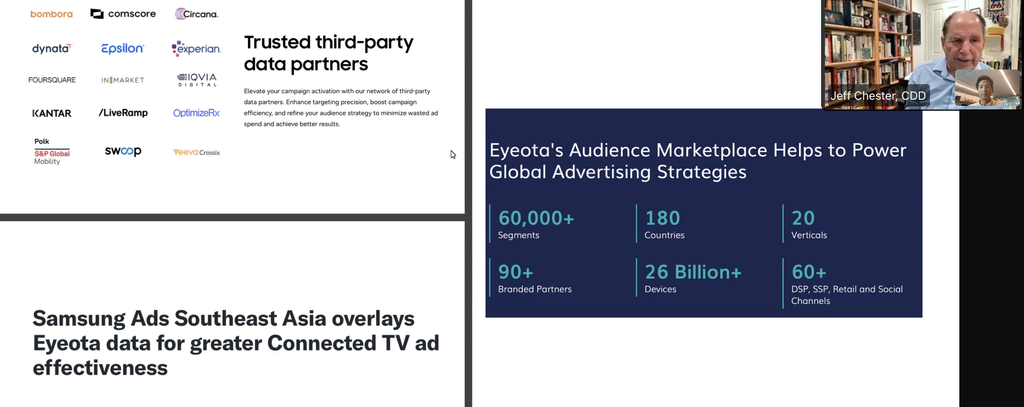

You’re watching the news when the TV asks you to accept updated terms. You accept the terms so you can get back to the program. Jeff Chester of the Center for Digital Democracy (CDD) used an experience of his own to illustrate the gap between that single choice on screen and the network behind it: device makers, streaming services, ad companies, and data intermediaries. Few viewers can take in that whole system in the middle of a broadcast.
The first session of Asia Data Privacy Day 2026 looked at how internet-connected television has become part of a wider system for collecting and using data for advertising. After Chester’s presentation, K. S. Park, a director of Open Net and a law professor at Korea University, brought in a South Korean case involving behavioral advertising.
Advertising that follows people across TV, the web, and shopping
Connected TV here means devices and services that deliver programs over the internet, including smart TVs. The experience can feel much like watching traditional television. Behind the screen, though, the streaming system can use viewing information to deliver ads and measure their performance.
Chester explained how streaming brought with it technologies and business practices already used in digital advertising. TV manufacturers and streaming providers sell more than slots before or after a program. They can offer advertisers ways to reach particular audiences in particular contexts. Chester cited a streaming service’s presentation of its ad offerings to Japanese advertisers, as well as an announcement about cooperation between Samsung and Amazon. What the industry calls viewing, browsing, and shopping “signals” comes from things people do.
Chester also discussed real-time bidding. When an opportunity to show an ad comes up, advertisers’ systems can bid automatically based on the audience they want to reach and the context in which the ad would appear. What is bought and sold is the opportunity to show an ad, but the price depends in part on who the system estimates will see it. Viewers see the ad that wins; they rarely see the criteria used to choose it.
Industry standards bodies publish glossaries and technical documents describing the types of data involved and how the transactions work. Chester encouraged civil society groups in Asia to use these materials to trace what is being traded and how.
AI helps decide when and to whom an ad appears
It’s easy to associate generative AI in advertising with writing copy or creating images. Chester focused on its role elsewhere in the process: defining audiences, deciding where in a program to insert an ad, and selecting what to show based on the viewer or the context.
One example was the use of AI to analyze themes, objects, and emotional context in video and apply those findings to ad placement. Analyzing a program to decide what kind of ad fits a scene is a different process from using accumulated data about someone to decide what to show that person. When both are part of ad delivery, it can be difficult for viewers to tell which factors drove the result.
Similarly, models built from customers’ behavior can be used to find other people predicted to have similar characteristics. A list of the information collected does not explain what that information can be used to infer or how it might shape what people see. Chester argued that the discussion needs to cover those inferences and interventions as well as the amount of data collected.
What is recorded outside the service you’re using?
Park drew on a case that South Korea’s data protection authority addressed in 2022 to explain how advertising networks can collect information about people’s behavior on third-party sites. Imagine a site about bicycles that participates in an ad network. Someone may visit just to read an article, but their activity there can be sent to the network and used to select ads they see elsewhere.
People may reasonably expect a video or social media service to know which videos they watched or which posts they reacted to on that service. Tracking on unrelated sites is less apparent at signup. In the case Park described, the Korean authority found that agreement to the platforms’ terms was insufficient consent to collect that off-platform activity.
Chester added that first-party data, which companies obtain through their own interactions with users, also warrants scrutiny. Data collected directly can accumulate over years of use and be combined with information from partner companies to support detailed inferences about people’s lives. Putting safeguards around the environment in which data is analyzed is a separate question from what combinations and inferences should be allowed there.
The speakers highlighted different parts of the problem. Park pointed to the gap between the boundaries of the service a person visits and the places their data actually goes. Chester emphasized that even data from a familiar service can end up being used in ways the person never imagined.
Looking beyond the consent screen
Someone who wants to get back to the news is unlikely to stop and investigate an entire advertising system. Asking for consent in that moment does not establish that the viewer understood the proposed uses or had a meaningful choice. Chester argued that opt-in consent was inadequate and called for substantive limits on what companies can collect, combine, and use.
Park closed by introducing a civil society alliance working on digital consumer rights across the Asia-Pacific and inviting others working on similar issues to collaborate. As services and advertising systems operate across borders, the viewer’s screen tells only part of the story. Companies, regulators, and civil society each see different parts of the system. Bringing those perspectives together is a starting point for understanding what is happening to people’s data.
You can see the report of the entire conference here. https://asia-privacy-day.privacybydesign.jp/ which covered the three issues below:
Keynote: Your Map Remembers. Does the Company Need to Remember, Too?
Michael Omoto
The Google Maps Timeline case illustrates how moving location history from company servers to devices can preserve useful functions while reducing the data centrally available for other purposes. Michael Omoto described engineering trade-offs, the “creepy cliff” and a possible direction for privacy-preserving AI assistants.
Session 1:Smart TV, Smart Glasses & Advertising Monitoring: While You Watch TV, What Is the Ad System Watching?
Jeff Chester · KS Park
Jeff Chester traced the advertising infrastructure behind connected TV, including audience targeting, real-time bidding and AI-driven placement. KS Park discussed a Korean case concerning behavioral data collected on unrelated sites. Both questioned whether a consent screen can make these complex practices understandable.
Session 2:Digital Trade & Data Protection: When Data Crosses Borders, How Can Consumers Be Heard?
Naoko Murai · Masafumi Mikami · Shota Watanabe
Masafumi Mikami described Global CBPR certification and how assessors evaluate company practices. Shota Watanabe discussed privacy in digital trade agreements; moderator Naoko Murai raised the challenge of making consumer participation in policymaking meaningful.
Session 3:Platforms & Age Assurance: How Can Platforms Protect Children and Preserve the Freedom to Publish Anonymously?
Peter Cui · Nicole T. I. Chan · YingShin Lee
Nicole T. I. Chan examined age-assurance methods that disclose only necessary attributes, while YingShin Lee described practical moderation at Matters. Moderated by Peter Cui, the discussion weighed child safety against the need to protect anonymous expression.
0 Comments