
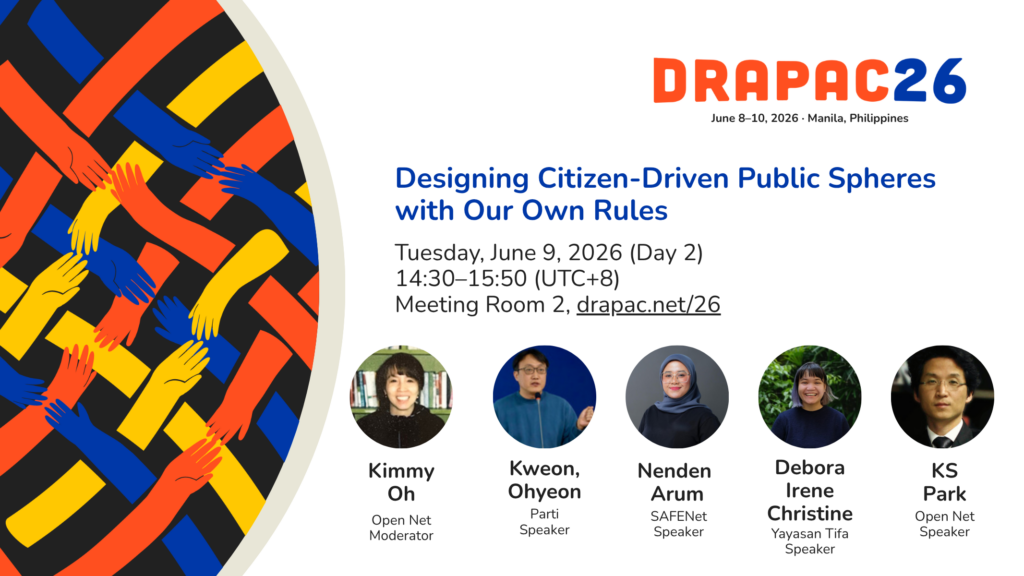
| Schedule | Tuesday, June 9, 2026 (Day 2)14:30–15:50 (UTC+8)Meeting Room 2, SMX Aura Convention Centre |
| Moderator and Speakers | KYOUNGMI OH, Open Net Korea Ohyeon KWEON, Parti Debora Christine, Tifa Foundation Nenden Arum, SAFENet Kyung Sin Park, Open Net |
When digital authoritarianism intensifies—where governments control information by blocking or pressuring specific giant platforms—societies dependent on a single platform face an instantaneous paralysis of their public sphere. However, the existence of decentralized alternative platforms makes uniform government censorship significantly more difficult. These platforms serve as "digital shelters" where civil society and citizens yearning for a democratic society can communicate, thereby ensuring the sustainability of democracy.
A landscape where platforms are monopolized by a few transnational tech giants fails to reflect the unique political contexts, minority languages, and cultural taboos of individual nations. Achieving platform diversity allows for the design of public spheres with rules tailored to the complex multi-ethnic and multi-religious realities of each country. This signifies a shift from "universal technology" to "technology that solves the specific problems of our society."
There was a time when platforms forming the public sphere played a major role in Korean society. However, as transnational Big Tech platforms gained dominance and the internet environment shifted heavily toward commercialization, the role of the internet as a public forum has continuously diminished. Nevertheless, a few dedicated actors have maintained a lineage of alternative platforms providing internet public spheres to promote democracy.
Open Net has been practicing various collaborations with Parti, which seeks to secure democracy through alternative platforms such as Demos X, Citizen Pass, and Factcheck Net, to bring about practical social change. This collaboration serves as living evidence of how "democratic platform diversity" can exert real influence in our society, even amidst the commercialization of the Korean internet and the shrinking of the public sphere. Similar efforts have attracted even wider attention in Taiwan such as vTaiwan and g0v.
These experiences offer crucial implications for Southeast Asian civil society, which is grappling with the dual challenges of digital authoritarianism and Big Tech monopoly. We can build the confidence to directly design rules that fit our own societal contexts. These valuable experiences demonstrate the hope that platforms can be more than just services—they can be a sustainable infrastructure for democracy.
We no longer wish to keep this record of small but solid cracks, built in Korea, as our own exclusive possession. Through this session, we aim to discuss in depth how to share and disseminate Korea’s practical experiences with civil society worldwide.
Beyond merely spreading technical solutions, we will explore specific methodologies for empowering citizens in each country to design and operate "digital public spheres" tailored to their own political and cultural contexts. We hope our solidarity will serve as the first step toward breaking down the barriers of digital authoritarianism and building a "democratic platform ecosystem" that transcends borders.
Korean version text
0 Comments