
26/10/2015
The table is produced with the data from 1) data published by Ministry of Science, ICT and Future Planning, which used the reports by communication service providers ; and 2) transparency report published by Naver and Daum Kakao, in which the number of requests and submitted data is disclosed.
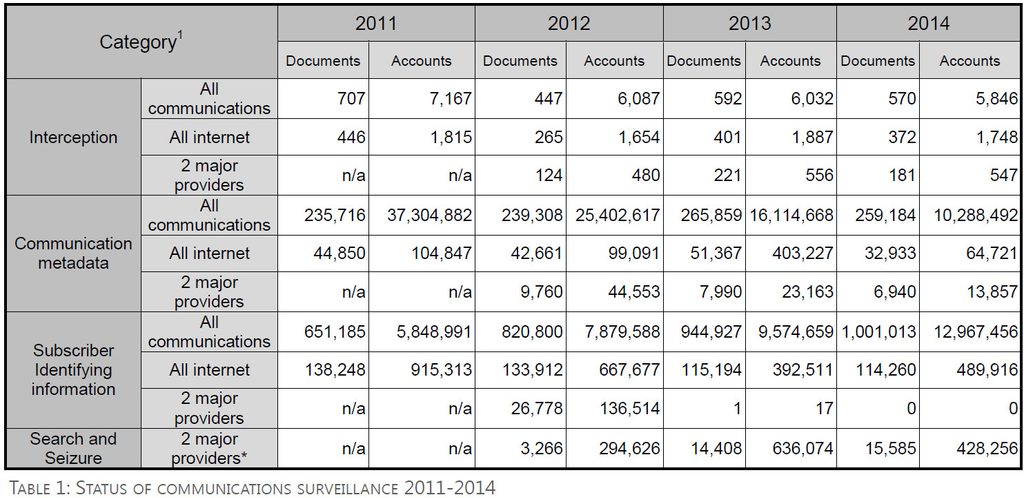
- On average, approx. 580 cases of Interception for all communications per year are conducted for approx. 6,300 accounts. Among them, Interception for internet is number approx. 370 per year, for approx. 1,800 accounts, which account for approx. 64%[1] of the total number of Interception.
- Acquisition of communication metadata (phone numbers, time, locations, etc.) for all communications number approx. 0.25 million cases on average per year, for approx. 20 million accounts. Among them, acquisition of communication metadata for internet number approx. 43,000 per year, for 0.17 million accounts, which is approx. 1% of the total (in terms of number of accounts), probably because requests are mainly made to operators of mobile telecommunications business, and focused on ‘cell tower dump’. The acquisition of these data is on the fall; accounts per document in 2011 were approx. 160, while they are only approx. 40 for the year of 2014. However, the fact that approx. 10 million accounts, amounting to 20% of the total population, are being subject to this Measure annually calls for strict scrutiny.
- Provision of subscriber identifying information is being made in the number of approx. 0.85 million cases per year, for approx. 9 million accounts. Provision of subscriber identifying information for internet service subscribers are being made in the number of approx. 125,000 cases per year, for approx. 600,000 accounts. This takes up about 6% of the total number of provision of subscriber identifying information (in terms of number of accounts). The provision of subscriber identifying information is on the rise, with agencies taking advantage of the fact that this measure does not require court order. 2014 saw the all-time high, with 1,001,013 requests and subscriber identifying information for 12,967,456 accounts provided.
- The data for search and seizure (which can be used for acquiring communications contents, metadata, and subscriber identifying information) on communication service providers are not available from the government. Only data disclosed to the public is the data provided in early 2015 by the two major online service providers in Korea – Naver and Daum Kakakao. According to them, the yearly totals search and seizure for these two providers number approx. 9,000, for approx. 0.45 million accounts on average.[2]. Since search and seizure is made to discern the ‘contents’ of the completed communications, one may estimate the search and seizure number for all service providers by taking into account the percentage of the two major service providers for the Interception above[3] with the result that information of approx. 1.5 million accounts of internet users or 5 million accounts of users of all forms of communications are being provided via search and seizure in the entire country. If this estimate is reasonable, search and seizure conducted on such a vast scale will be certainly the most serious problem, as it allows the government to see the contents of the communications.
- If we look at the data provided by the two major service providers, for surveillance for major internet services (email, messenger, community, etc.), it is worrisome that while acquisition of communications metadata and subscriber identifying information is decreasing, powerful methods of surveillance such as Interception – which can see the ‘contents’ of the communications – and search and seizure – which can comprehensively collect all data including the contents of the communications – is on the rise.
[1] In terms of number of documents (in terms of accounts, approx. 30%)
[2] Search and seizure for Kakao excluded, as the number of accounts is missing
[3] In terms of accounts, approx. 30% of all internet, and 9% of all communications
댓글 0개