
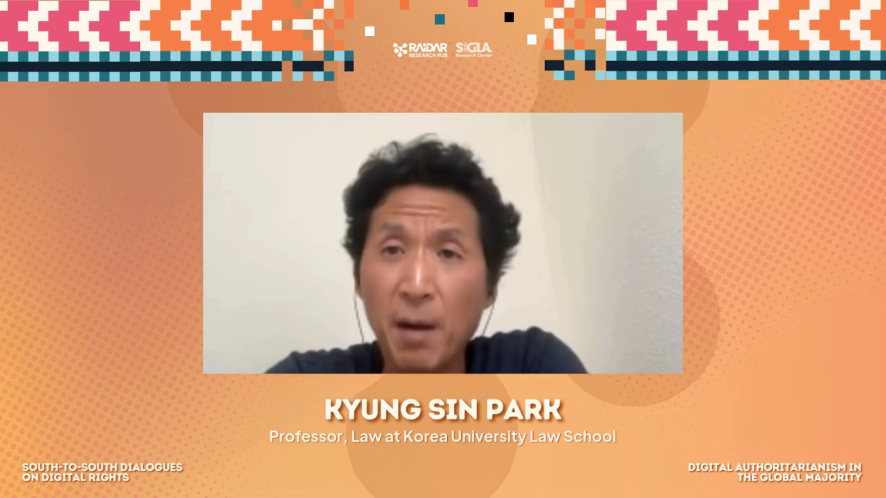
On August 28, 2026, Open Net was invited to speak on digital authoritarianism and its manifestation in Korea. KS Park spoke on the following issues as eloquently reported by the host Sigla Research Center:
Governments are growing savvier with how they package digital authoritarianism. In Korea, as Professor Kyung Sin Park pointed out, authorities are packaging a controversial anti-disinformation bill as a “Korean way” to respond to digital falsehoods. In truth, he says, it's a tactic from the same playbook: censorship, plain and simple.
He specifically talks about how this repackaging was made possible because of distortions in the discourse on the European Union’s Digital Services Act. Since Trump packaged the DSA as a censorship bill, Korean legislators used it for their argument: if the Europeans can censor speech, why can’t we?
KS Park explained that US and EU have built platform regulation on the foundation of intermediary liability safe harbor and thereby harnessed the voluntary powers of platforms in scaling up moderation of illegal content through DMCA and DSA respectively, and that Korea instead created a new category of digital contraband called "disinformation" (which is not illegal under Korean law and is protected under international human rights law anyway) and is trying to shut down its circulation by compulsive force of the state or punitive damages measure which will cause a huge number of "false positives" and the risk of political bias in content moderation. Administrative censorship (i.e., an executive branch trying to moderate online content) is bound to be vague and excessive as one can see from the shutdown of Women On Web in Korea and also its statutory mandate of moderating "what is necessary for sound communication ethics". Other Asian countries doubling down on administrative censorship are bound to have equally vague or excessive categories, he warned.
0 Comments